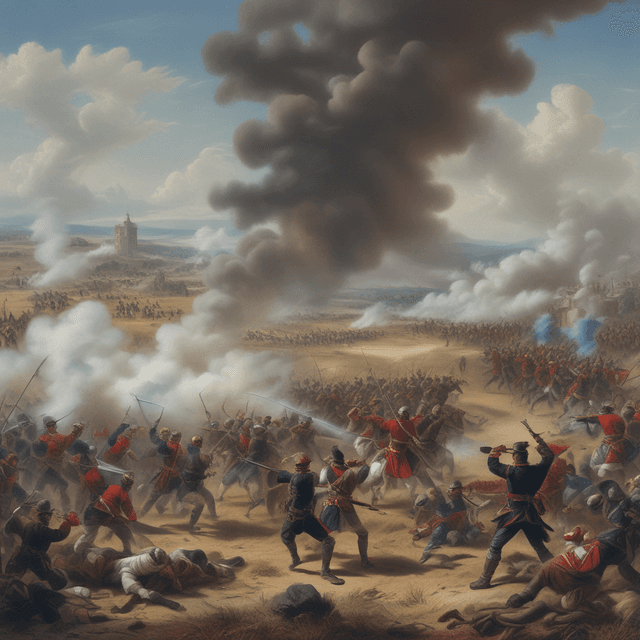
| Name | Prusso-Austrian War of 1839 |
| Cause | |
| Result | Prussian victory, establishing Prussia as dominant German power |
| Consequences | Breakdown of the German Confederation • Paved the way for Prussian unification of Germany |
| Significance | Major turning point in German history with far-reaching geopolitical consequences |
| Parties involved |
The Prusso-Austrian War of 1839, also known as the Schleswig-Holstein War, was a short but pivotal military conflict between the German Confederation states of Prussia and Austria over the control of the duchies of Schleswig and Holstein. The war resulted in a decisive Prussian victory that fundamentally altered the balance of power in Central Europe and set the stage for the later unification of Germany under Prussian leadership.
The duchies of Schleswig and Holstein had long been a source of tension between Prussia and Austria due to their ambiguous constitutional status within the German Confederation. Both German states claimed authority over the duchies, which were populated by German, Danish and mixed ethnic communities.
In 1838, the ruling Danish monarchy attempted to more tightly integrate Schleswig and Holstein into the Danish kingdom, sparking outrage from German nationalist factions in the duchies. Prussia and Austria, as the two most powerful German states, mobilized their armies to intervene, each claiming the right to protect the interests of their fellow Germans in the disputed territories.
When diplomatic efforts failed, the Prusso-Austrian War broke out in March 1839. The initial Austrian offensive, led by the experienced General Radetzky, quickly pushed Prussian forces back. However, the Prussian Chief of the General Staff, Helmuth von Moltke, employed a bold new military strategy that would prove decisive.
Moltke organized Prussian forces into highly mobile, combined-arms units equipped with the latest breech-loading rifles and artillery. This enabled them to outmaneuver and outgun the more rigid Austrian formations still relying on muzzle-loading muskets. Prussian cavalry also played a key role, conducting daring raids and disrupting Austrian supply lines.
After several fierce battles over the spring and summer, the Prussians achieved a major breakthrough at the Battle of Kolding in July 1839. This crushing defeat left the Austrians unable to mount an effective counteroffensive, and Prussian forces quickly occupied Schleswig and Holstein, securing their control of the duchies.
The Prusso-Austrian War of 1839 was a decisive victory for Prussia and a devastating blow to Austria's prestige and influence within the German Confederation. The speed and decisiveness of the Prussian triumph demonstrated the growing military might of the Hohenzollern kingdom.
The breakdown of the German Confederation in the wake of the war paved the way for Prussian dominance and the eventual unification of Germany under Prussian leadership in 1871. Austria, humiliated by its defeat, shifted its focus eastward, strengthening its position in the Austro-Hungarian Empire. This altered the geopolitical landscape of Central Europe for decades to come.
The legacy of the 1839 conflict also had a profound impact on military thinking. Moltke's innovative combined-arms strategy and use of breech-loading firearms foreshadowed the tactics and technologies that would define modern warfare in the late 19th and early 20th centuries. Prussian military supremacy, forged in this pivotal war, would go on to shape the course of European history.
